


Promise of the Christian Faith
By Rev Tan Eng Boo
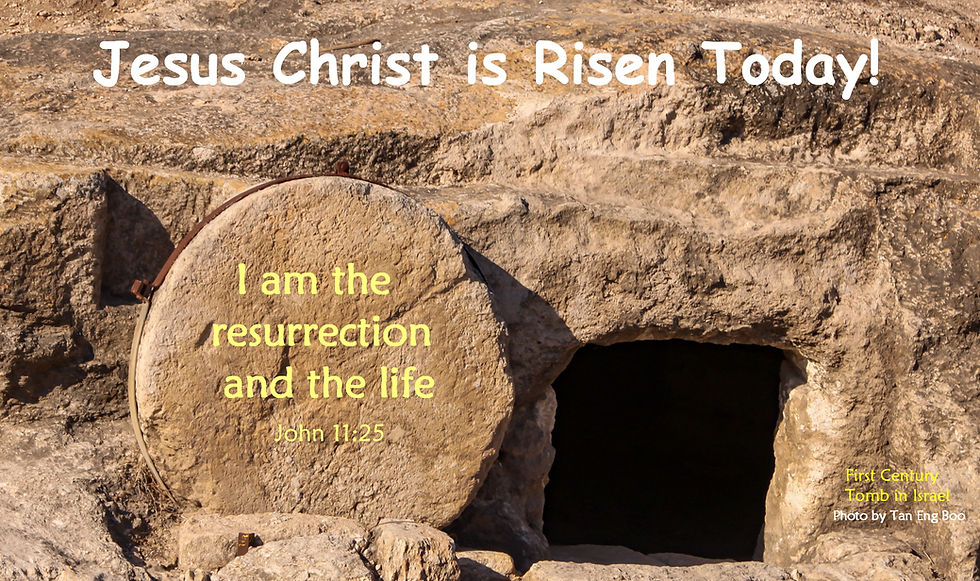
The central promise of the Christian faith is beautifully expressed in the words of Jesus recorded in John 11:25–26:
“I am the resurrection and the life. Whoever believes in me, though he die, yet shall he live, and everyone who lives and believes in me shall never die. Do you believe this?”
These words are profound, yet they can also sound puzzling—even unbelievable. I recall attending a Christian vigil service where this passage was read aloud before the sermon. An interpreter rendered it in Mandarin for the congregation. Sitting behind me were two elderly women who, upon hearing the translation, whispered to each other in Hokkien, “How can that be? If a person is dead, how can he be alive?” Their reaction reflected both confusion and offence. Yet, despite their doubts, they remained and listened attentively to the message.
Their question is not unusual. Death is the most certain reality of human life. From the moment we leave the cradle, we begin our journey toward the grave. It is therefore natural to ask: how can a person die and yet live? Where is the logic in such a statement?
This is not a new question. Thousands of years ago, a man named Job wrestled with the same issue. He asked:
“If a man dies, shall he live again? All the days of my service I would wait, till my renewal should come.” (Job 14:14)
From a human perspective, death appears final. A person does not return to live again on this earth, and any hope of such a return seems futile. Yet Job spoke of waiting for a “renewal”—a change beyond death. His words reveal a deep and unwavering confidence in God. In the midst of suffering and uncertainty, Job made a remarkable declaration of faith:
“For I know that my Redeemer lives, and at the last he will stand upon the earth. And after my skin has been destroyed, yet in my flesh I shall see God; whom I shall see for myself, and my eyes shall behold, and not another. My heart faints within me!” (Job 19:25–27)
Here lies the heart of the Christian hope: death is not the end. When Jesus spoke the words, “though he die, yet shall he live,” He was addressing Martha, the sister of Lazarus, who had just died. In that moment of grief, Jesus pointed her—and all who hear His words—to a greater reality. This promise is grounded in His own death and resurrection.
Jesus later affirmed this truth when He said:
“Because I live, you also will live.” (John 14:19)
The Christian faith rests on this assurance. Eternal life is not merely a wish or an abstract idea; it is a promise secured by the risen Christ. It is offered to all who receive Him as their Lord and personal Saviour.
At the same time, the Bible explains why death exists. It tells us that death entered the world as a result of sin. Yet, it does not leave us without hope:
“For the wages of sin is death, but the free gift of God is eternal life in Christ Jesus our Lord.” (Romans 6:23)
This gift of eternal life cannot be earned—it is given freely. The question, then, is how to receive it. The answer is simple and direct:
“Believe in the Lord Jesus, and you will be saved, you and your household.”
(Acts 16:31)
The promise of the Christian faith is clear: those who believe in Jesus Christ will live, even though they die. Death is not the end, but the doorway to eternal life. For believers, there is the assurance of living forever with Christ in heaven.
The question Jesus asked Martha still speaks to us today:
“Do you believe this?” (John 11:26)
Death cannot keep his prey, Jesus, my Saviour!
He tore the bars away, Jesus, my Lord!
And up from the grave He arose,
With a mighty triumph o’er His foes.
He arose a Victor from the dark domain,
And He lives forever with His saints to reign,
He arose! He arose! Hallelujah! Christ arose!
-Robert Lowry


Comments